
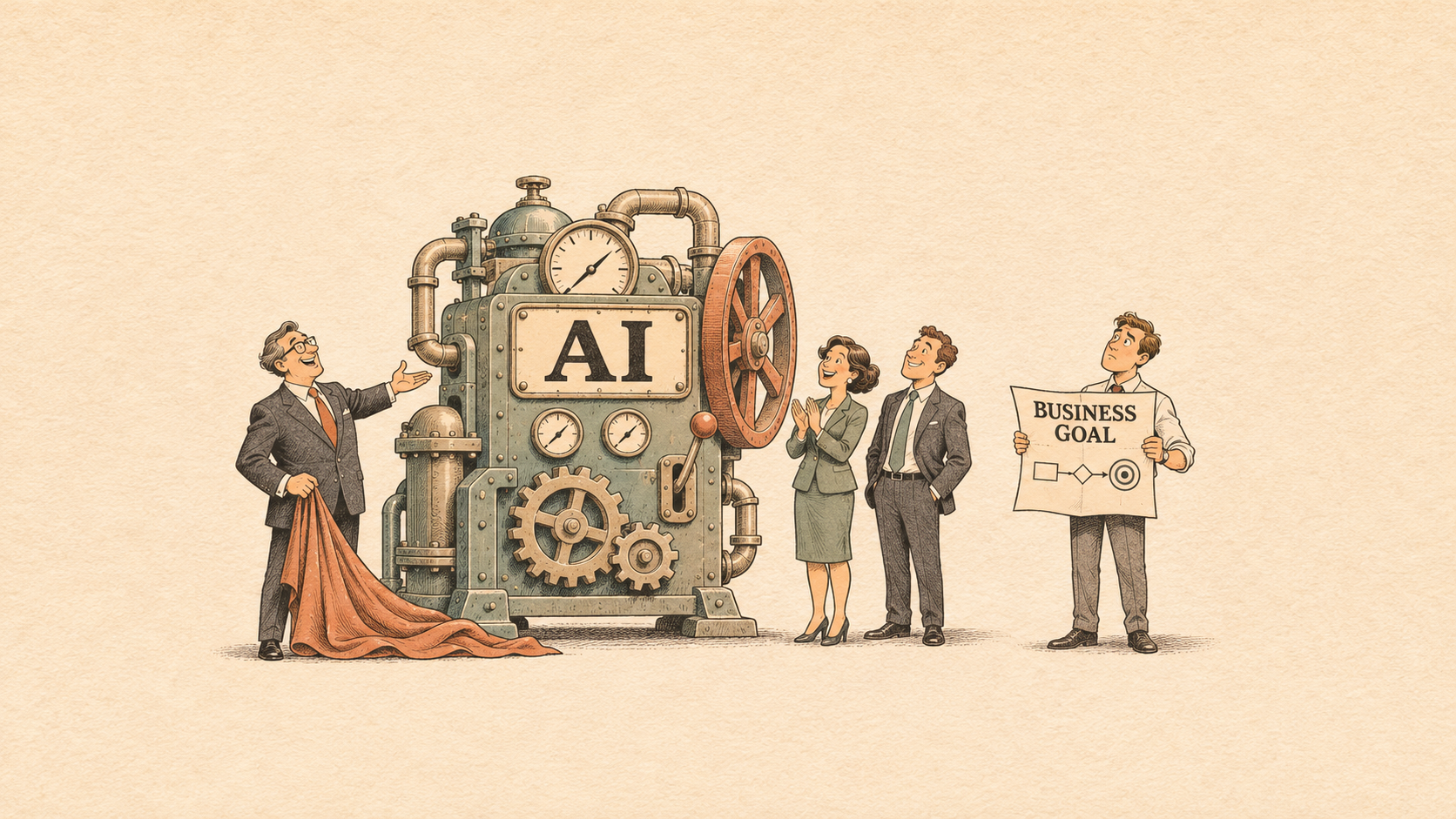
AI can make organizations faster, smarter, and more effective. But adopting AI isn't a business strategy in itself. The value comes from connecting the technology to a specific business problem, redesigning the work around it, and measuring whether anything meaningful actually improved.
I've noticed something interesting about the way companies talk about AI. A few years ago, the question was whether organizations were investing in artificial intelligence. Now, the question seems to be how quickly they can demonstrate that they're using it.
AI-powered products. AI-enabled workflows. AI-first organizations. AI transformation strategies. Everyone has an AI strategy. Or at least an AI slide in their strategy presentation.
And while I'm genuinely excited about what this technology makes possible, I think we're sometimes confusing the adoption of a capability with the achievement of a business objective.
AI isn't the destination. It's one of the ways we might get there.
That distinction sounds obvious, but I don't think we're consistently applying it.
Nobody wakes up wanting an AI implementation.
Well, maybe a few people in the technology industry do. But most business leaders wake up thinking about the problems they're responsible for solving: revenue growth, profitability, customer retention, employee productivity, competitive pressure, and the need to deliver better experiences without continually increasing costs.
AI might help address those challenges. But the challenges existed before AI became the headline of every technology conference. And they'll still exist when the next technology trend comes along.
I've spent much of my career helping organizations connect technology investments to business priorities. One thing that experience has reinforced is that technology is most valuable when we can explain why it matters without relying on the technology's name.
Imagine a retailer wants to improve customer retention. That's a business objective. Using AI to identify changing customer behaviors, predict potential disengagement, or determine more relevant experiences might support that objective. But simply announcing that the marketing team has adopted AI doesn't tell us whether customer retention is improving.
The technology is a capability. The strategy is what the organization is trying to accomplish and how it intends to get there.
Making something faster doesn't necessarily make it better.
One of the most compelling promises of AI is efficiency. And there's plenty of opportunity. Tasks that once required hours can sometimes be completed in minutes. Teams can analyze information more quickly, generate content at greater scale, and automate work that previously required substantial manual effort.
Those improvements can be valuable. But efficiency is more complicated than reducing the time required to complete an individual task.
Consider a marketing team that takes two weeks to launch a campaign. The organization introduces an AI tool that reduces copywriting time from three hours to ten minutes. Impressive. But what if the campaign still takes two weeks to launch? What if the real bottlenecks are data availability, approvals, technical implementation, or quality assurance?
The team has improved one part of the process without necessarily improving the outcome of the process. That's not a failure of AI. It's a failure to understand where the problem actually lives. And it illustrates why I'm increasingly interested in conversations about workflows rather than isolated tasks.
A useful way to evaluate an AI investment is to look at three levels of impact:
- Task: Did we make an individual activity faster, easier, or more accurate?
- Workflow: Did that improvement change how work moves through the organization?
- Business: Did the resulting change improve an outcome the organization actually cares about?
Those are related, but they aren't interchangeable. Saving someone two hours is useful. Eliminating a recurring bottleneck that prevents an entire team from delivering work on time could be transformative. That's how we need to be thinking about AI, whether we're the ones investing in the tech or selling it.
The technology doesn't fix the process by itself.
There's an old tendency in enterprise technology to assume that introducing a more sophisticated platform will somehow resolve the organizational problems surrounding it. It rarely works that way.
If a process has unclear ownership, inconsistent data, competing priorities, and unnecessary approvals, adding AI doesn't automatically make those problems disappear. In some cases, it simply allows the organization to move through a broken process more quickly.
Congratulations 🥳. We've automated the confusion. 🤔
The more interesting opportunity is to use AI adoption as a reason to reconsider how work should happen.
Which activities still require human judgment? Which steps exist because of limitations that no longer apply? Where are people spending time reconciling information instead of making decisions? What needs to change so the organization can actually benefit from the new capability?
These aren't exclusively technology questions. They're questions about organizational design, accountability, and leadership. And they require participation from the people who understand how the work gets done, not just the teams responsible for implementing the software.
AI should make people more capable, not just more productive.
There's another part of the conversation I think deserves more attention. We often evaluate AI through the lens of productivity: how much more work can someone complete in the same amount of time? That's a reasonable question. But it's not the only one.
What if AI could help someone make a better decision? What if it gave a less experienced employee access to information that previously required years of institutional knowledge? What if it helped a team recognize a problem earlier, understand a customer more deeply, or explore possibilities they wouldn't otherwise have had time to consider?
Those benefits may be harder to capture in a simple productivity calculation, but they can be enormously valuable. I've always believed that the best technology makes people more effective at the work that matters.
Sometimes that means removing repetitive tasks. Sometimes it means improving the quality of the information available to them. And sometimes it means helping people focus their attention on the decisions, relationships, and creative thinking that require human judgment.
The goal shouldn't simply be to produce more output. It should be to produce better outcomes.
Experimentation matters. So does knowing what you're experimenting with.
I don't want to suggest that every AI initiative needs a fully developed business case before anyone is allowed to explore it. That would be a terrible way to learn.
Some of the most valuable discoveries happen when people experiment, test assumptions, and explore capabilities before they know exactly where the technology will fit. I'm a big believer in making room for that kind of curiosity.
But there's a difference between experimentation and enterprise-wide investment. When an organization moves from exploring AI to committing significant resources, the expectations should change. At that point, leadership should be able to articulate a few things clearly:
- The problem: What business challenge are we trying to address?
- The change: What will people or systems do differently?
- The investment: What will implementation, adoption, and ongoing management require?
- The measure: How will we know whether the investment delivered value?
That doesn't mean the answers will always be perfect. It means we're being intentional about what we're trying to accomplish. And importantly, it gives us a way to recognize when something isn't working and change course.
The most valuable AI strategy might not mention AI first.
I suspect the organizations that ultimately create the most value from AI won't necessarily be the ones that talk about it the most. They'll be the ones that understand their business well enough to identify where the technology can make a meaningful difference.
They'll know which problems are worth solving, which workflows need to change, and which outcomes matter. They'll also recognize that AI isn't always the answer.
Sometimes a process needs to be simplified. Sometimes the data needs to be fixed. Sometimes teams need clearer responsibilities. And sometimes a perfectly ordinary piece of automation will do the job without requiring anyone to describe it as revolutionary.
That's okay. The objective isn't to win an award for using the most AI. It's to build a better business.
So the next time someone tells me their organization has an AI strategy, I'm interested. But what I'd really love to hear is what they're trying to accomplish. Because that's where the interesting conversation begins.
And if AI helps them get there, fantastic. That's what it's for.

Julio Lopez
I've spent more than 16 years helping enterprise brands connect their business priorities with the technology and strategies needed to deliver better customer experiences and measurable results.
My career has spanned marketing technology, personalization, AI, and customer engagement, with roles at CheetahMail/Epsilon, RevTrax, Eversight, Movable Ink, and Validity. Throughout that time, I've worked at the intersection of business strategy and technology, helping organizations turn complex capabilities into practical solutions that drive growth, strengthen customer relationships, and deliver meaningful outcomes.
More about Julio ↗