
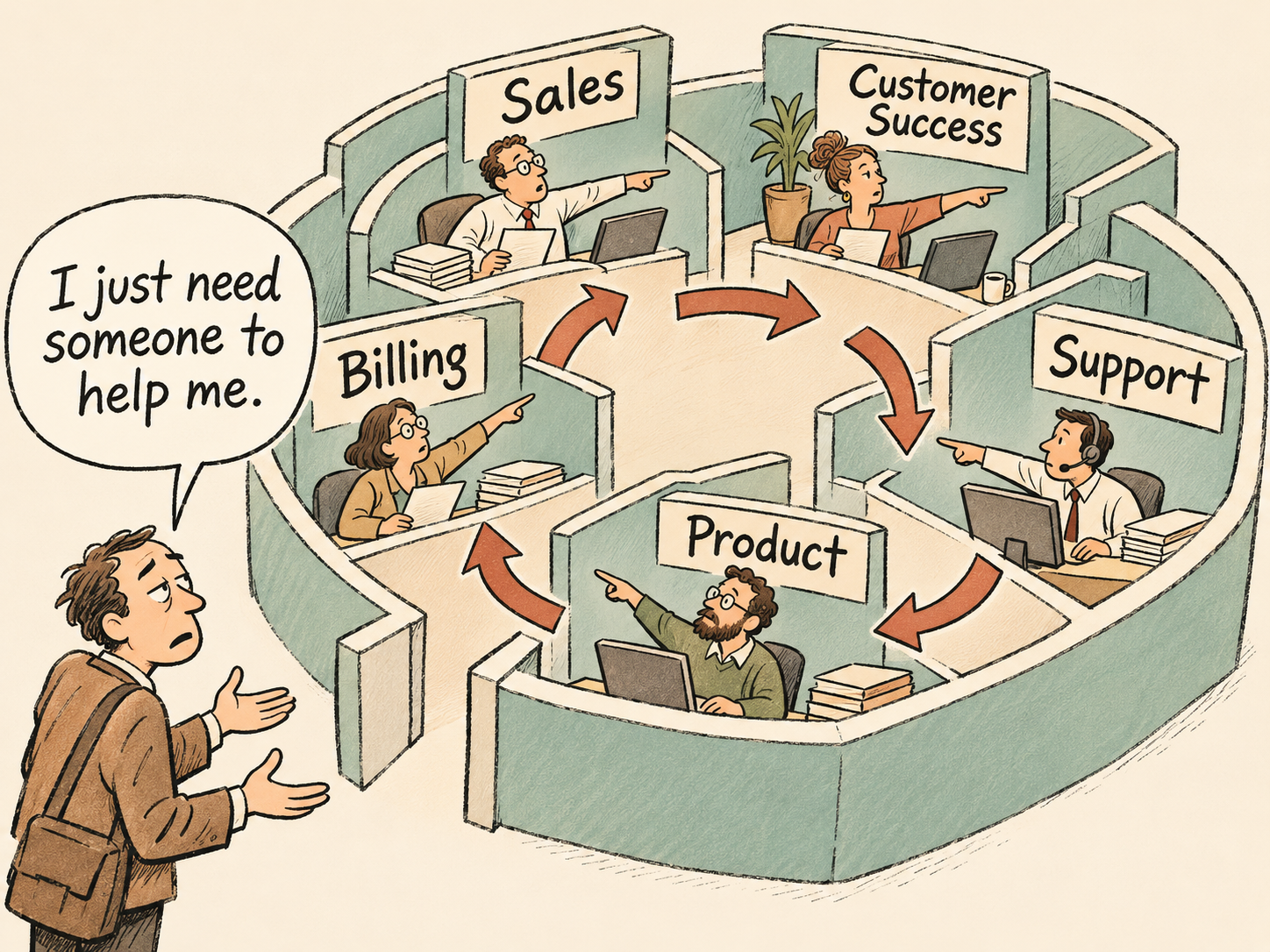
Customers experience one company, even when the work behind the scenes spans Sales, Customer Success, Account Management, Product, and Support. Clear ownership matters, but handoffs, competing incentives, and lost context can undermine the relationship. The best teams align around customer outcomes, not just departmental responsibilities.
I've spent much of my career working in roles that don't fit neatly into one department. Strategy. Customer Success. Account Management. Sales. Sometimes a little Product, Analytics, or Marketing thrown in for good measure.
Depending on the company, the title changes. The responsibilities shift. And occasionally, I find myself explaining what I actually do to someone who has worked with me for six months.
But there's a common thread running through all of it: helping customers achieve something meaningful while making sure the business can deliver on its promises.
That sounds straightforward. Until you introduce an org chart.
The org chart makes perfect sense. Internally.
Organizations need structure. Teams need clear responsibilities, accountability, and leadership. I'm certainly not suggesting we abandon departments and let everyone figure it out as they go. That sounds like a terrible Tuesday.
But the way a company organizes itself isn't necessarily the way its customers experience it. A customer doesn't think about whether their problem belongs to Customer Success, Account Management, Product, or Support. They have a problem. They need help solving it.
They don't particularly care that the person who sold them the solution isn't the person responsible for implementing it. Or that their strategic advisor doesn't own the commercial relationship. Or that a feature request needs to pass through three different teams before anyone can provide an answer.
Those distinctions may be perfectly reasonable internally. Externally, they can feel like friction. And when customers repeatedly have to navigate that friction, the relationship starts to suffer.
Handoffs are where good intentions go to die.
Think about a typical enterprise software relationship. A Sales team spends months understanding a customer's challenges, building relationships, and demonstrating how a solution can help. The deal closes. Everyone celebrates.
Then the customer meets an implementation team that may not have been involved in those conversations. A few months later, Customer Success takes the lead. Account Management becomes more involved as renewal approaches. Product gets pulled in when something isn't working as expected.
Every team might be doing its job well. But is anyone making sure the customer experiences one continuous relationship?
I've seen how easily valuable context can get lost between functions. A business priority discussed during the sales process becomes a technical implementation requirement. A strategic objective turns into a list of product features. A customer conversation about growth becomes a discussion about contract terms.
None of those translations is necessarily wrong. But something important can disappear along the way: the original reason the customer invested in the technology. And that's often the most valuable piece of information we have.
Alignment isn't another meeting.
When organizations recognize this problem, the instinct is often to create more opportunities for teams to communicate. More meetings. More shared documents. More status updates. More Slack channels.
I'm all for collaboration, but I'm not convinced that adding another recurring meeting to everyone's calendar is the answer. The goal isn't simply to get people talking. It's to get them working toward the same outcome.
That starts with a shared understanding of what success looks like for the customer.
- Not just whether the implementation was completed on time.
- Not just whether the customer adopted a particular feature.
- Not just whether the contract renewed.
Those are important measures, but they're not interchangeable with customer value.
What was the customer trying to accomplish when they bought the solution? Has that priority changed? What progress have they made? What's getting in their way? And what does the next stage of success look like?
When different teams can answer those questions consistently, collaboration becomes much more productive. Suddenly, Product understands why a particular capability matters. Customer Success can connect adoption to business priorities. Account Management can identify expansion opportunities grounded in actual customer needs. And Sales can learn which promises translate into lasting value.
That's alignment. The meeting is optional.
The customer relationship belongs to the company.
One of the more challenging aspects of enterprise customer management is the question of ownership. Who owns the customer? Sales? Account Management? Customer Success?
My answer is that someone absolutely needs to be accountable for coordinating the relationship. But that doesn't mean the customer relationship belongs exclusively to one function. There's a difference between accountability and ownership.
A designated relationship leader can provide continuity, manage priorities, and ensure that commitments don't fall through the cracks. But delivering value usually requires contributions from across the organization.
A customer might need technical expertise one week, strategic guidance the next, and commercial flexibility a month later. The relationship succeeds when those capabilities work together. It struggles when the customer has to figure out how to assemble them.
And while this sounds like a customer experience issue, it's also a leadership issue. Leaders establish the incentives, processes, and expectations that determine whether teams collaborate or compete.
If every department is measured exclusively on its own outcomes, we shouldn't be surprised when people optimize for those outcomes. Sometimes at the expense of the bigger picture.
Retention is an outcome, not a department.
I've worked with organizations where retention is primarily associated with Customer Success or Account Management. That makes sense from an accountability standpoint. Someone needs to own the number.
But customers don't renew because a renewal process was executed flawlessly. They renew because the relationship continues to make sense for their business.
That might mean they're achieving measurable results. It might mean the solution has become essential to their operations. It might mean they trust the people supporting them to help navigate challenges and identify new opportunities. Usually, it's some combination of all three.
And none of those outcomes can be delivered by a single department acting alone. Product quality matters. Implementation matters. Support matters. Strategic guidance matters. Commercial relationships matter.
Which means improving retention often requires looking beyond the team officially responsible for it.
Design around the customer, not just the company.
I'm not advocating for eliminating organizational boundaries. Specialization is valuable. Clear accountability is essential. And as companies grow, structure becomes increasingly important.
But structure should make it easier to deliver value, not harder. That requires leaders to look at the business from the customer's perspective.
- Where are customers repeating themselves?
- Where are commitments getting lost?
- Where are internal incentives creating unnecessary friction?
- Where do teams have different definitions of success?
- And perhaps most importantly, who is responsible for making sure the customer experience feels connected from beginning to end?
Those aren't questions for Customer Success alone. They're questions for the entire leadership team.
I've spent a lot of time working between functions, and one thing has become clear to me: some of the most valuable work happens in the spaces between the boxes on an org chart. That's where context gets connected, competing priorities get reconciled, and strategy turns into execution.
The org chart might tell you who reports to whom. It doesn't tell you whether the customer is getting what they need. And ultimately, that's what matters.

Julio Lopez
I've spent more than 16 years helping enterprise brands connect their business priorities with the technology and strategies needed to deliver better customer experiences and measurable results.
My career has spanned marketing technology, personalization, AI, and customer engagement, with roles at CheetahMail/Epsilon, RevTrax, Eversight, Movable Ink, and Validity. Throughout that time, I've worked at the intersection of business strategy and technology, helping organizations turn complex capabilities into practical solutions that drive growth, strengthen customer relationships, and deliver meaningful outcomes.
More about Julio ↗