
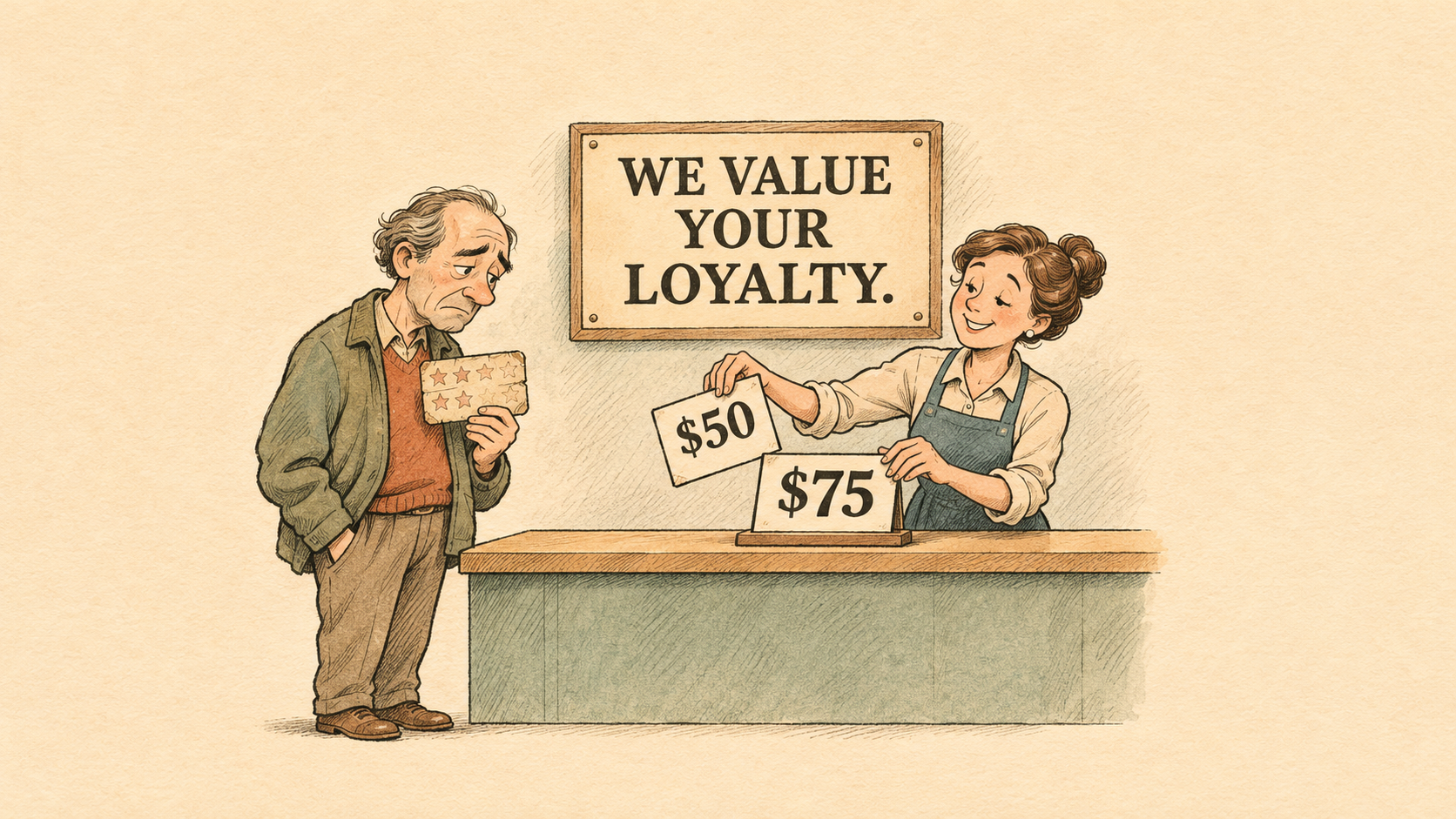
Price increases are sometimes necessary, but how a company communicates them can matter as much as the increase itself. Customers aren't just evaluating the new price. They're reconsidering the value of the relationship, how they've been treated, and whether they still want to be part of it.
I love a good subscription. Coffee delivered to my door. Products I use regularly. Services that make life a little easier. There's something wonderful about finding a company you like, signing up, and not having to think about it again. Until you get that email. The one announcing that your subscription price is increasing.
Now, I understand that businesses have expenses. Costs rise. Supply chains change. Employees deserve to be paid. Companies need to invest in their products and services. I'm not suggesting that a business should never raise its prices. But as someone who has spent much of my career thinking about customer relationships, retention, and growth, I find myself paying particular attention to how companies handle these moments.
Because a price increase isn't just a financial transaction.
It's a moment when customers reassess the relationship.
And the way a company handles that moment can either reinforce the relationship or damage it.
The price isn't always the problem.
Let's imagine you've subscribed to a service for several years. You like the product. You appreciate the convenience. You've recommended it to friends. You might even feel a little emotionally invested in the brand. Then you receive an email announcing a price increase. Maybe the increase is modest. Maybe it's substantial.
But the first question that comes to mind isn't necessarily whether you can afford it. It's whether the company still values your business. That might seem irrational from a purely financial perspective, but customer relationships aren't purely financial. People develop expectations about the brands they choose.
They remember when a company has treated them well. They notice when the experience changes. And they form opinions about whether they're getting a fair exchange of value. A price increase can interrupt that sense of fairness, particularly when it arrives without much explanation. The customer starts asking questions:
- What changed? Is the product or service improving?
- Why now? What's driving the increase?
- What about my loyalty? Does my history with this company count for anything?
- Is it still worth it? Would I make the same decision if I were signing up today?
Those questions are entirely reasonable. And companies should anticipate them.
Loyalty is a two-way street.
Businesses love talking about loyal customers. We measure retention. We build loyalty programs. We celebrate repeat purchases and long-term subscribers. But loyalty can't be something we expect from customers without demonstrating it ourselves. If someone has been paying for your service for years, that history should mean something.
I'm not necessarily arguing that longtime customers should be exempt from every price increase. That may not be financially sustainable, and it could create other problems. But acknowledging the relationship matters. A simple message that recognizes the customer's history, explains the reason for the change, and expresses appreciation for their continued support can make a difference.
Better yet, companies can consider whether there are meaningful ways to recognize loyalty. That might mean offering a transition period, preserving an existing benefit, providing an alternative subscription option, or simply giving customers more time to decide. None of those approaches is universally appropriate.
But they demonstrate that the company has considered the impact on the people who helped build its business. There's a difference between telling customers their price is changing and showing them you've thought about what that change means for them.
Transparency is more useful than corporate language.
I've read plenty of price increase announcements that manage to use several paragraphs without clearly explaining why the price is going up. They're filled with phrases about continued investment, delivering exceptional experiences, and maintaining a commitment to quality. Those things may be true. But they often sound like language that has been carefully reviewed by six departments to avoid saying anything particularly specific.
Customers can tell. If your costs have increased, explain that. If you're investing in improvements, tell customers what those improvements are. If the economics of your business have changed, be candid about it. You don't need to publish your financial statements or explain every operational detail. You just need to treat customers like adults who are capable of understanding a business decision.
And please, make the actual price change easy to find. Customers shouldn't need to scroll through three paragraphs of appreciation to discover what they'll be paying next month. A good announcement should make a few things immediately clear:
- What's changing: The old price, the new price, and the difference.
- When it's changing: The date the new price takes effect.
- Why it's changing: A straightforward explanation without unnecessary jargon.
- What options exist: Whether customers can change plans, pause, or cancel.
- What happens next: Whether they need to take action or the change will happen automatically.
Clarity isn't a particularly glamorous customer experience strategy. But it's an effective one.
Don't confuse a successful price increase with a successful customer outcome.
Here's where my professional background makes me look at this differently. From a business perspective, increasing prices can be an attractive way to grow revenue. If customers continue paying, the company generates more revenue without necessarily acquiring more customers. On a spreadsheet, that can look fantastic.
But the spreadsheet doesn't always tell the whole story.
Consider a subscription business that increases prices by 15%. If most customers accept the change, the immediate financial impact might be positive. But what happens if some customers begin questioning the value of the service? What if they become less engaged, stop recommending the brand, or start exploring alternatives?
What if the price increase doesn't cause an immediate cancellation, but weakens the relationship enough that the next inconvenience becomes the reason they leave? Those effects can take time to appear. And they may not show up in the metrics used to evaluate the initial pricing decision. That's why I think companies need to consider more than the immediate revenue impact.
They should also look at customer behavior, retention over time, engagement, complaints, and changes in how customers perceive the value they're receiving.
A price increase can be financially successful in the short term while creating a customer problem in the long term.
Both things can be true.
Value is personal, and it changes.
One of the challenges with pricing is that companies often think about value in terms of what they provide. Customers think about value in terms of what they receive. Those aren't always the same thing. A company might introduce new features, expand its offering, or invest in capabilities that make the product objectively more sophisticated.
But if a customer doesn't use those capabilities, they may not see the additional value. I've seen this dynamic throughout enterprise technology, and it applies just as easily to consumer subscriptions. A business can make a compelling case for why its product costs more to deliver. That doesn't automatically mean the customer believes it's worth more to them.
And sometimes the issue isn't whether the product has improved. It's whether the customer's needs have changed. The coffee subscription that felt like a wonderful discovery a few years ago might now be competing with different priorities, habits, or alternatives. A price increase can force customers to reconsider a decision they'd otherwise been happy to leave on autopilot.
That's a risk companies shouldn't underestimate.
Sometimes the best retention strategy is giving customers a choice.
There's a temptation to make cancellation difficult when a company is worried about retention. More steps. More screens. More opportunities to reconsider. I understand the business motivation. But making it harder to leave doesn't necessarily make someone more likely to want to stay. In fact, it can turn a mildly disappointing experience into a genuinely negative one.
I'd much rather see companies use a price change as an opportunity to understand what customers value. Maybe someone would prefer a less expensive plan with fewer benefits. Maybe they'd like to reduce delivery frequency. Maybe they need to pause their subscription for a while. Or maybe they're ready to leave.
Giving customers meaningful choices can preserve relationships that might otherwise end. And even when someone does cancel, a respectful experience leaves the door open for them to return. That's worth something.
The relationship is bigger than the next invoice.
I don't think most customers expect prices to remain unchanged forever. They understand that the world changes and that businesses have to adapt. What they want is to feel that the company they've supported recognizes their side of the relationship. That's not an unreasonable expectation. And it doesn't require a business to sacrifice its commercial interests.
It requires thoughtful communication, a clear understanding of customer value, and a willingness to look beyond the immediate financial benefit. For companies, a price increase is often a pricing decision. For customers, it can feel like a relationship decision. The best businesses understand that both perspectives matter.
And if you're going to charge someone more for the privilege of continuing to do business with you, the least you can do is explain why. Preferably before the next invoice arrives.

Julio Lopez
I've spent more than 16 years helping enterprise brands connect their business priorities with the technology and strategies needed to deliver better customer experiences and measurable results.
My career has spanned marketing technology, personalization, AI, and customer engagement, with roles at CheetahMail/Epsilon, RevTrax, Eversight, Movable Ink, and Validity. Throughout that time, I've worked at the intersection of business strategy and technology, helping organizations turn complex capabilities into practical solutions that drive growth, strengthen customer relationships, and deliver meaningful outcomes.
More about Julio ↗