
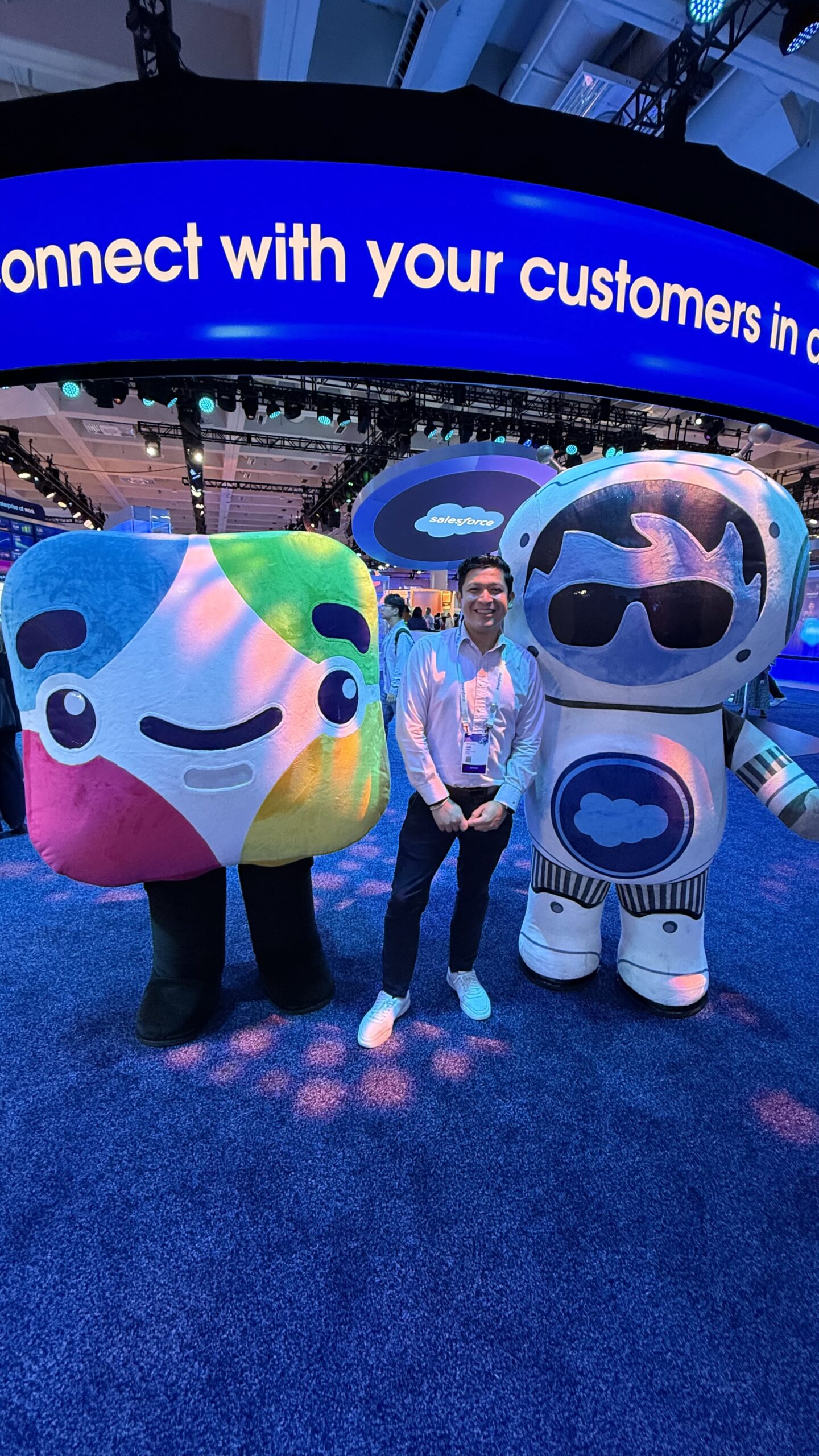
AI is everywhere, but its language is becoming harder to distinguish. After walking the Dreamforce floor, I came away with a simple conviction: start with the business problem, look beyond the demo, and demand clarity about what changes, who benefits, and how you'll know it worked.
I walked 18,000 steps around the Salesforce Dreamforce conference floor in San Francisco this year. I learned a lot. I had some great conversations. I saw some impressive technology.
And at a certain point, I started wondering whether every company had hired the same marketing agency.
Agents. Automation. Intelligence. Personalization. Orchestration. Transformation.
Booth after booth, presentation after presentation, the language started to blur together. I remember thinking: What does your company actually do?
I'm exaggerating a little. But only a little.
To be clear, I'm genuinely excited about AI. I've spent years working at the intersection of marketing, technology, data, and customer experience. I've seen firsthand how technology can change what businesses are capable of doing.
But I've also spent enough time in enterprise software to know that an impressive demonstration and a valuable business solution are not necessarily the same thing. And right now, separating the two is getting harder.
The problem isn't too much AI. It's too little differentiation.
The pace of innovation is extraordinary. Capabilities that would have sounded ambitious a few years ago are becoming increasingly accessible. That's a good thing.
The challenge is that as technology advances, the language used to describe it seems to be getting less specific. Nearly everyone is promising greater efficiency, smarter decisions, better customer experiences, and improved business outcomes.
Those are worthwhile goals. They're also so broad that they tell me very little about why one solution is different from another.
Take the word agent, for example. Are we talking about a tool that retrieves information? Something that recommends an action? A system that executes a series of tasks? Or technology that makes decisions and takes action with limited human intervention?
Those are meaningfully different capabilities, with different implications for implementation, governance, and business value. Yet they can all end up under the same headline.
I'm not suggesting that every company is deliberately being vague. Sometimes the technology really is difficult to explain. Sometimes the market hasn't settled on a shared vocabulary. And sometimes marketing teams are trying to communicate something genuinely new in the few seconds they have to capture someone's attention.
But the result is the same: buyers have to work harder to understand what they're evaluating.
Start with the problem, not the promise.
When I'm evaluating a new capability, I try to get past the terminology and understand the actual work it changes.
- What problem are we solving?
- Who experiences that problem today?
- What happens differently when this technology is introduced?
- And how would we know whether the change was worthwhile?
Those questions sound almost embarrassingly basic. But I think they're becoming more important, not less.
Imagine a marketing team that takes days to launch a campaign because information has to move between analytics, creative, engineering, and quality assurance.
An AI tool that produces campaign copy in seconds might be impressive. But if writing the copy was never the bottleneck, have we meaningfully improved the process? Maybe. Maybe not.
Now imagine a capability that helps the team identify the right audience, coordinate the necessary information, reduce manual handoffs, and catch potential issues before deployment. That's a different conversation.
The point isn't that one use of AI is inherently better than another. It's that the value depends on the problem you're actually trying to solve.
Those connections need to be demonstrated.
The demo is the beginning of the conversation.
I love a good product demo. I appreciate thoughtful product design, and I'm easily impressed when technology makes something complicated look effortless.
But enterprise technology doesn't operate in a demo environment. It operates inside organizations with existing systems, competing priorities, imperfect data, security requirements, budget constraints, and people who already have more work than they can reasonably manage.
That's where the questions get interesting.
- What data does the solution need?
- How much effort does it take to connect it to the systems already in place?
- What happens when something goes wrong?
- Who owns the decisions it makes?
- What does a person still need to review or approve?
And perhaps most importantly, what needs to change inside the organization to realize the promised value?
A technology investment can be technically successful and still fall short of its business potential. I've seen enough complex technology implementations to appreciate that the capability itself is only part of the equation. Adoption, processes, ownership, and measurement matter just as much.
That isn't an argument against moving quickly. It's an argument for understanding what you're moving toward.
You don't need to know everything. You do need to keep learning.
One of the more uncomfortable things about working in technology right now is the feeling that you're perpetually behind. There's another product launch. Another model. Another acquisition. Another company announcing that it has reinvented an entire category.
And if your job involves advising customers or helping businesses make technology decisions, there's pressure to have an informed opinion about all of it. I feel that pressure, too.
But I've become increasingly comfortable admitting when I don't understand something. Not because understanding doesn't matter. Quite the opposite.
Pretending to understand a technology because I recognize the vocabulary isn't particularly useful to me or to the people relying on my judgment. I'd rather ask a basic question than walk away with a sophisticated-sounding explanation I can't translate into a business outcome.
That means talking to people, seeing demonstrations, challenging assumptions, and occasionally discovering that something I initially dismissed is more interesting than I thought. It also means accepting that no one person can keep up with every development in AI.
Curiosity is a much more sustainable strategy than pretending to be an expert in everything.
The real differentiator is clarity.
I left Dreamforce excited about what AI could make possible. I also left convinced that the companies that explain their value most clearly will have an advantage over those that simply use the most impressive terminology.
- Tell me what changes.
- Tell me who benefits.
- Show me how it works in the real world, not just in an ideal demonstration.
- Help me understand the tradeoffs.
- And give me a credible way to measure whether it worked.
That doesn't mean every innovation needs an immediate financial return to deserve attention. Experimentation matters. Learning matters. Sometimes you need to explore a capability before you fully understand where it belongs.
But exploration and investment are different decisions, and we should be clear about which one we're making.
As for me, I'll keep asking questions, talking to people, and trying to separate the signal from the noise. If that requires another 18,000 steps around a conference floor, so be it.
I should probably invest in better shoes.

Julio Lopez
I've spent more than 16 years helping enterprise brands connect their business priorities with the technology and strategies needed to deliver better customer experiences and measurable results.
My career has spanned marketing technology, personalization, AI, and customer engagement, with roles at CheetahMail/Epsilon, RevTrax, Eversight, Movable Ink, and Validity. Throughout that time, I've worked at the intersection of business strategy and technology, helping organizations turn complex capabilities into practical solutions that drive growth, strengthen customer relationships, and deliver meaningful outcomes.
More about Julio ↗