
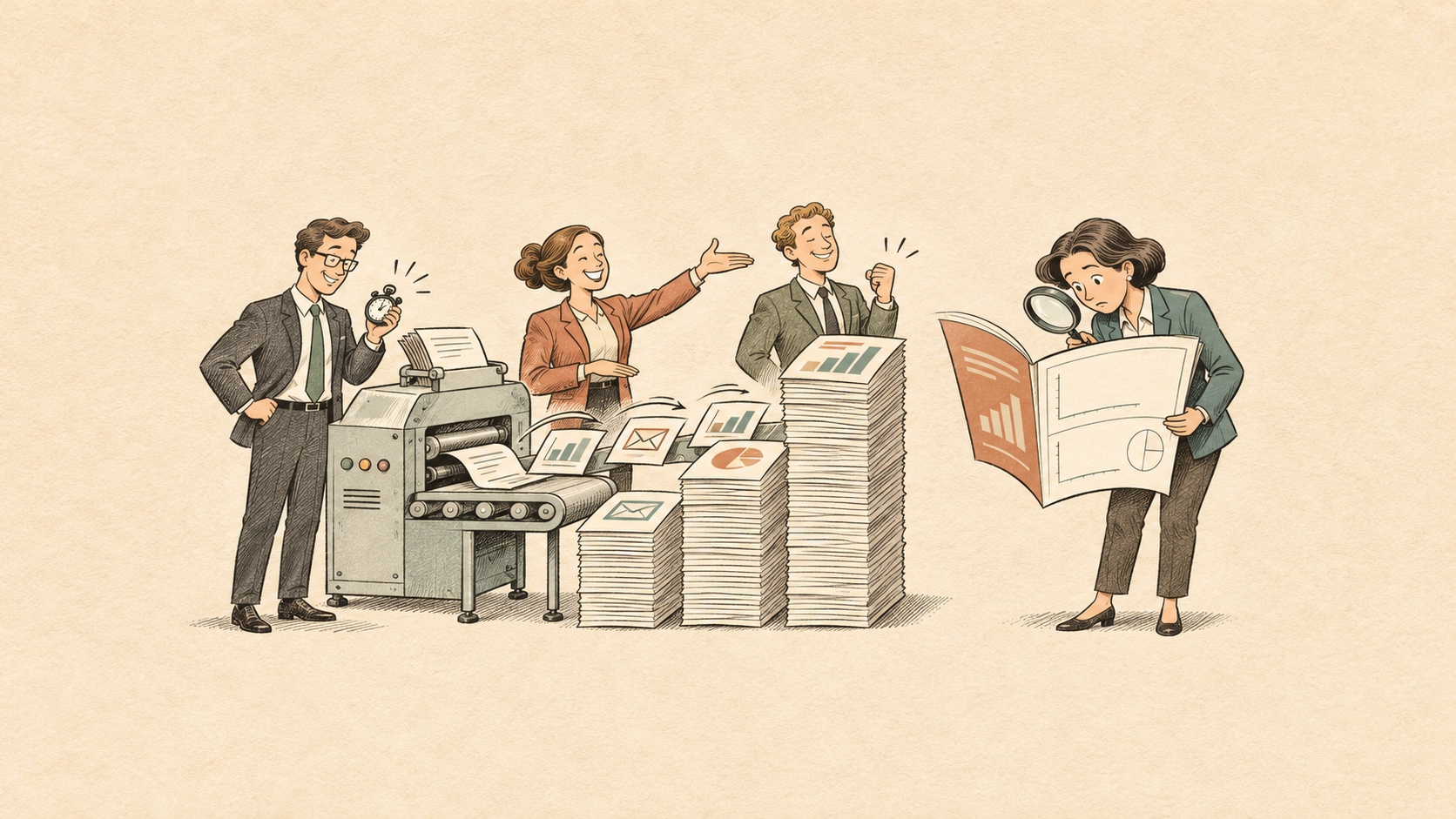
AI is transforming how quickly we can write, analyze, create, and make decisions. But speed isn't the same as quality, and productivity isn't the same as impact. The opportunity isn't simply to accomplish more tasks in less time. It's to use the time and capabilities AI gives us to do more meaningful, thoughtful, and valuable work.
I love AI. I use it. I experiment with it. I get excited when I discover something that would have taken me hours to accomplish just a few years ago. And I genuinely believe we're witnessing a remarkable shift in how people work. But lately, I've been thinking about something. We're getting incredibly good at producing things quickly.
Presentations. Reports. Emails. Analyses. Strategies. Meeting summaries. Content. More content. And then, just for good measure, a summary of all that content. It's impressive. But I keep coming back to one question:
Are we actually making the work better, or are we just making more of it?
The productivity numbers don't tell the whole story.
One of the most common ways organizations evaluate AI is through time savings. A task that previously took three hours now takes 20 minutes. A report that required several days can be generated in an afternoon. A team can produce twice as much content without increasing headcount. Those are meaningful improvements. But I think we need to be careful about what we conclude from them.
Saving two hours doesn't automatically mean the organization created two hours of value. It means someone has two hours available that they didn't have before. What happens next is what matters. Does that person use the time to solve a more important problem? Develop a better idea? Spend more time with customers? Improve the quality of their work? Or does the organization simply fill those hours with more tasks?
There's a difference between creating capacity and creating value. And I worry that in our enthusiasm for efficiency, we're sometimes treating those two things as interchangeable.
We've made it easier to create. Have we made it easier to think?
I spend a lot of time working with presentations. Throughout my career, I've created and delivered more slides than I care to count. Strategic recommendations, customer business reviews, executive presentations, research findings, and the occasional deck that probably didn't need to exist. One of the hardest parts of creating a good presentation has never been putting words on slides. It's figuring out what you actually want to say.
What's the argument? What evidence supports it? What does the audience need to understand? And perhaps most importantly, what should they do differently after hearing it? AI can help tremendously with that process. It can organize information, challenge assumptions, identify gaps, and help turn complicated ideas into something more accessible.
But it can also produce 20 beautifully structured slides about a subject nobody has thought through particularly well. And because those slides look polished, it can create the impression that the underlying thinking is equally polished. That's where I think we need to be careful.
A well-designed presentation isn't necessarily a well-developed argument.
The same is true of reports, strategies, recommendations, and almost anything else AI can help us produce. The quality of the output still depends on the quality of the thinking behind it.
The danger of making mediocre work look excellent.
One of the fascinating things about generative AI is how confidently it can present information. Give it a vague prompt, and it can produce something that looks remarkably professional. A strategy with clear headings. A business case with compelling language. An executive summary that sounds like it belongs in a board presentation. And sometimes, the substance is genuinely useful. Other times, it's a collection of reasonable-sounding statements that don't say very much.
The language is polished. The structure is logical. The conclusions seem plausible. But there's no distinctive insight. No real understanding of the business. No evidence that anyone has challenged the assumptions. Just a very professional-looking document that could apply to almost any organization. We've all encountered that kind of work before AI. Now we can produce it in seconds. Congratulations. We've dramatically improved the efficiency of being generic.
I say that with affection, because I've certainly caught myself being impressed by an AI-generated response before realizing that it hadn't actually answered the question I was asking. The solution isn't to avoid AI. It's to become more demanding about what good work looks like.
Good judgment becomes more valuable, not less.
I think one of the most important skills in an AI-enabled workplace will be the ability to evaluate what technology produces. Not just whether something is technically correct, but whether it's useful. Does the recommendation make sense in context? Are the assumptions reasonable? Is the evidence strong enough? Does the conclusion reflect the realities of the business? Those questions require judgment. And judgment comes from experience, curiosity, critical thinking, and a willingness to challenge what initially appears convincing.
AI can support that process. It can help us explore alternatives, identify contradictions, and consider perspectives we might otherwise overlook. But it doesn't eliminate our responsibility to decide what we believe and why. In fact, the easier it becomes to generate plausible answers, the more important it becomes to distinguish between an answer that sounds good and one that's actually good. That's not a technology problem. That's a leadership and professional development challenge.
What happens to the learning that used to happen along the way?
There's another part of this conversation that I don't think gets enough attention. Many of the skills we develop professionally come from doing difficult, sometimes tedious work. Building an analysis from scratch. Trying to make sense of messy information. Writing a first draft that isn't very good. Reworking a presentation because the argument doesn't hold together. Those experiences can be frustrating. They can also be how we learn.
I think about the early stages of my career, when I had to work through problems without having immediate access to something that could generate a polished answer. The process wasn't always efficient. But it forced me to understand the material, recognize patterns, and develop my own point of view.
Now, imagine someone early in their career who can use AI to produce work that looks comparable to something a much more experienced professional might create. That's an extraordinary opportunity. But it raises an important question.
How do we make sure people are developing the judgment behind the work, not just the ability to produce it?
I don't believe the answer is to make people do everything the hard way. That would be like insisting someone use a paper map because GPS might prevent them from learning directions. But I do think organizations need to be intentional about how people learn when technology removes some of the steps that traditionally developed expertise. Perhaps that means spending more time explaining why a recommendation is right.
Asking people to defend their assumptions. Encouraging them to compare alternatives rather than accepting the first plausible answer. Or giving less experienced employees opportunities to participate in higher-level decisions earlier in their careers. AI can accelerate learning. But only if we design the work to support it.
More output isn't always more progress.
There's something almost comical about how quickly technology can expand our expectations. When email made communication easier, we didn't necessarily end up with less communication. We ended up with more email. When collaboration tools made it easier to schedule meetings and share information, we didn't necessarily eliminate unnecessary meetings. We found new ways to have them.
And now that AI can help us produce documents, presentations, and analyses faster, I wonder whether we're about to create an entirely new category of work devoted to reviewing things nobody really needed to produce in the first place. I hope not. Because the real opportunity is much more interesting. What if we used AI to eliminate unnecessary work instead of simply accelerating it?
What if teams spent less time preparing status updates and more time solving the problems those updates describe? What if customer-facing professionals spent less time assembling presentations and more time understanding the businesses they're advising? What if leaders spent less time consuming reports and more time making decisions? That's the version of AI-enabled productivity I find exciting. Not more work.
Better work.
We need a better definition of productivity.
I don't think the right question is simply how many hours AI saves. I think it's what those hours make possible. For individuals, that might mean more time for learning, creativity, and thoughtful problem-solving. For teams, it might mean fewer bottlenecks, better collaboration, and higher-quality decisions.
For businesses, it should ultimately mean outcomes that matter: stronger customer relationships, improved performance, more innovation, or a better experience for the people doing the work. And yes, sometimes it will mean lower costs. That's a legitimate outcome, too. But we should be careful not to reduce the entire opportunity to how much more output we can generate with fewer resources. The most valuable organizations won't necessarily be the ones that produce the most AI-generated work.
They'll be the ones that develop the judgment to know which work is worth doing.
The goal isn't to work faster forever.
I'm excited about where AI is taking us. I think it will change how we learn, create, collaborate, and solve problems in ways we're only beginning to understand. But I hope we don't mistake the ability to do something quickly for a reason to do it at all. A faster presentation isn't valuable if it doesn't help someone make a better decision. A more detailed report isn't useful if nobody acts on it.
And producing twice as much content isn't necessarily an achievement if none of it says anything new. The opportunity is to use technology to raise the quality of our thinking, not simply the volume of our output. So yes, let's celebrate the hours we're saving. Let's embrace the tools that make difficult work easier. But let's also be a little more ambitious about what we do with the time.
Because the real promise of AI isn't that we'll be able to do more work. It's that we'll be able to do better work.
And perhaps, if we're really lucky, we'll finally have fewer meetings about the meetings we're planning to have. Although I'm not holding my breath.

Julio Lopez
I've spent more than 16 years helping enterprise brands connect their business priorities with the technology and strategies needed to deliver better customer experiences and measurable results.
My career has spanned marketing technology, personalization, AI, and customer engagement, with roles at CheetahMail/Epsilon, RevTrax, Eversight, Movable Ink, and Validity. Throughout that time, I've worked at the intersection of business strategy and technology, helping organizations turn complex capabilities into practical solutions that drive growth, strengthen customer relationships, and deliver meaningful outcomes.
More about Julio ↗