
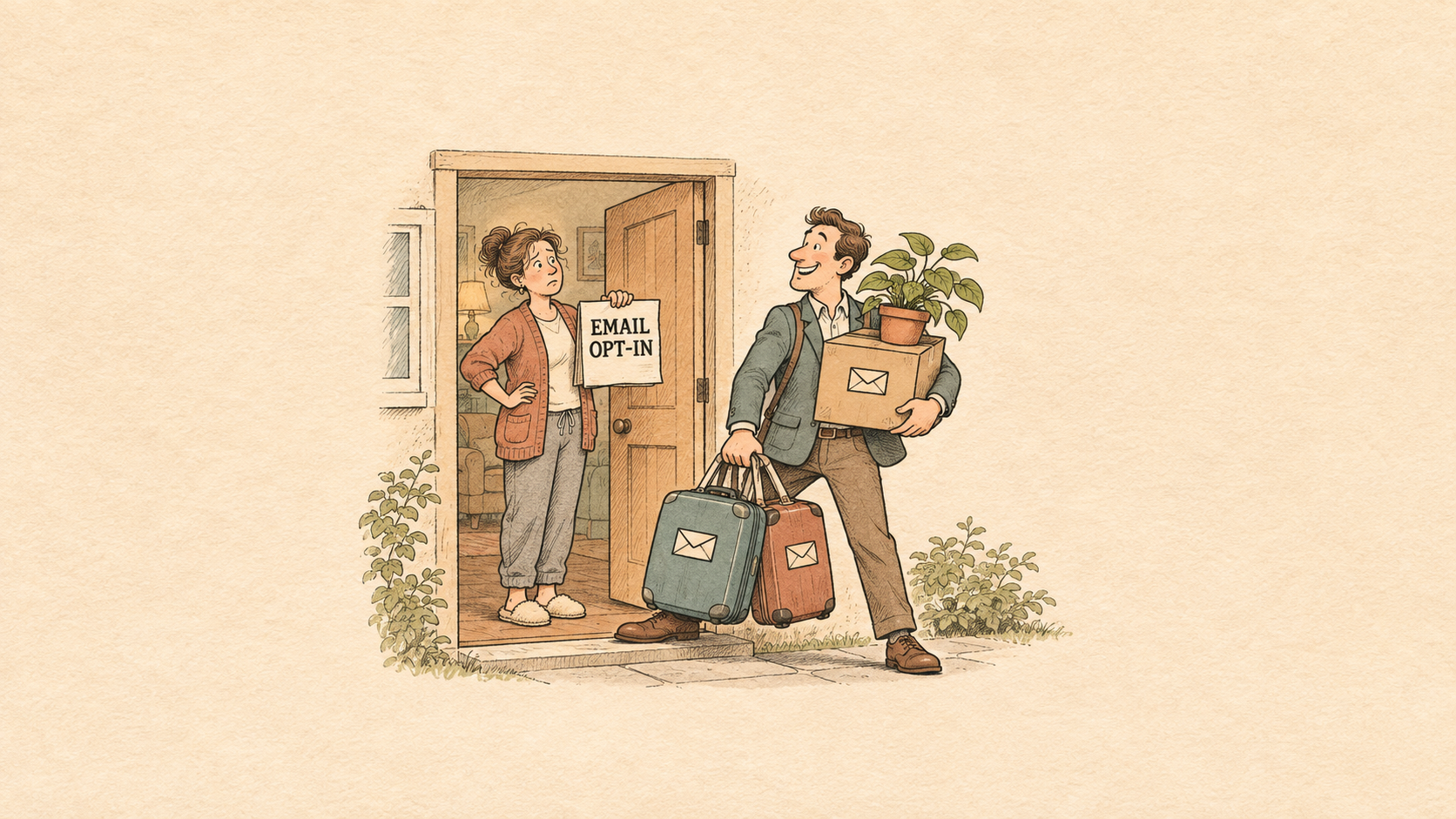
Email remains one of the most valuable channels in marketing, but more messages don't automatically create more value. When teams optimize individual campaigns without considering the customer's overall experience, they risk trading short-term engagement for long-term fatigue. Sometimes the smartest marketing decision is not to send another email.
A while back, I received 18 marketing emails from the same brand in eight days. Eighteen. That's more than two emails a day, on average. From one company. I like to think I'm a pretty engaged consumer. I subscribe to marketing emails from brands I enjoy, I appreciate a good promotion, and I genuinely admire thoughtful marketing. I've also spent a significant portion of my career working with the technology that powers these experiences.
So I'm probably more forgiving than most people when it comes to a busy inbox. But even I have limits. By the time I noticed just how many emails this brand had sent, I wasn't thinking about its latest promotion. I was wondering why it needed to talk to me so much. And that got me thinking about a question I wish more marketing teams would ask:
Just because we can send another email, does that mean we should?
Every campaign makes sense. Until you see them together.
Here's what makes this problem interesting. I suspect that if you looked at each of those 18 emails individually, there was probably a perfectly reasonable business justification for sending it. A new product launch. A limited-time promotion. A reminder that the promotion was ending. A weekend offer. A special event. A message about the event ending. And perhaps one more reminder, just in case I'd somehow missed the previous seventeen.
Each campaign might have had a clear objective, an audience, a revenue forecast, and a team responsible for delivering it. But the customer doesn't experience those campaigns as separate business initiatives. They experience them as a relationship with a brand. And from that perspective, 18 emails in eight days can feel less like a thoughtful marketing strategy and more like someone repeatedly tapping you on the shoulder.
The campaign calendar might be perfectly organized. The customer experience might still be a mess.
That's the disconnect.
Your customer isn't thinking about your campaign calendar.
One of the recurring challenges in marketing is that organizations tend to structure their work around internal priorities. Different teams own different product categories, promotions, customer segments, or business objectives. And each team has a legitimate reason to communicate. But those priorities can accumulate. The merchandising team wants to promote a new collection. The loyalty team has an offer. The lifecycle team wants to encourage another purchase. The brand team has an announcement.
Before you know it, the customer is receiving messages from every direction. And while each team may be meeting its individual goals, nobody is necessarily evaluating the combined experience. This is especially important in large organizations where marketing calendars, budgets, and performance targets are distributed across multiple teams. The customer doesn't know who owns the campaign. They don't care which department requested the send. They just know their inbox is getting crowded.
Which brings me to something I believe strongly:
The customer experience should be managed at the customer level, not just the campaign level.
That requires a different way of thinking about marketing decisions.
Engagement doesn't tell the whole story.
Email marketing is wonderfully measurable. We can track deliveries, opens, clicks, conversions, revenue, and countless other indicators of performance. That's one of the reasons I love the channel. But the availability of metrics doesn't automatically mean we're measuring the right things. Imagine a retailer sends an additional promotional email and generates incremental clicks and purchases. The campaign looks successful. Now imagine the retailer repeats that approach over and over.
At some point, the additional messages may generate diminishing returns. Customers may stop paying attention, disengage, or unsubscribe. And some customers might continue receiving the messages while gradually becoming less enthusiastic about the brand. That's harder to see in a campaign performance report.
The challenge is that a campaign can perform well individually while contributing to a worse customer experience collectively.
Both things can be true. That's why I think email performance needs to be evaluated beyond the results of a single send. Some questions worth considering:
- Incrementality: Did the message generate additional value, or would the customer have purchased anyway?
- Frequency: How many messages has this customer received recently, across all campaigns?
- Engagement trends: Is the customer's interest increasing or declining over time?
- Long-term value: Are we strengthening the relationship or simply extracting another transaction?
- Opportunity cost: Would a different message, channel, or moment have been more effective?
These aren't always easy questions to answer. But they're important ones.
Personalization should include knowing when to stop.
We've spent years talking about personalization in marketing. And for good reason. The ability to deliver relevant content, recommendations, and offers has transformed how brands communicate with customers. More recently, AI has expanded what's possible by helping organizations make decisions at a scale that would have been difficult to imagine not long ago. But I think one of the most overlooked dimensions of personalization is restraint.
Knowing what someone might be interested in is useful. Knowing when they might be interested is better. And knowing when to leave them alone might be better still. Consider a customer who has just made a significant purchase. Does that person need another promotional email the next morning encouraging them to buy something similar? Maybe. But perhaps a useful post-purchase message, a product care tip, or simply a short break from promotional communications would create more value.
The right answer depends on the customer, the context, and the business objective. That's precisely why I believe personalization is fundamentally about decision-making, not just content. It's not enough to determine which version of an email someone should receive. We should also be asking whether they should receive an email at all.
Deliverability is part of the customer experience.
There's another dimension to excessive sending that marketers sometimes overlook. Email deliverability. An email can be beautifully designed, perfectly personalized, and strategically timed. But none of that matters if it doesn't reach the inbox. Mailbox providers evaluate signals that help them determine whether recipients want the messages they're receiving. When people consistently ignore, delete, or complain about unwanted emails, those behaviors can affect a sender's reputation and inbox placement.
That means the consequences of excessive sending aren't limited to annoying individual customers. They can affect the performance of the broader email program. And that creates an interesting cycle. A brand wants more revenue, so it sends more emails. As engagement weakens, it may become harder to reach customers effectively. The brand responds by increasing volume or trying additional campaigns to compensate. At some point, more sending can become part of the problem rather than the solution.
The answer isn't necessarily to send less across the board. It's to send more intentionally.
The best marketing calendar might have fewer campaigns.
I know this isn't always an easy argument to make inside a business. Marketing teams have revenue targets. Campaigns have forecasts. Promotions have deadlines. And when a channel consistently generates measurable revenue, it's understandable that organizations want to use it. But I think there's a difference between maximizing the output of a channel and maximizing its value. More emails might produce more revenue in the short term.
That doesn't mean the relationship is becoming more valuable over time. A more thoughtful approach might involve:
- Coordinating campaign priorities across teams rather than evaluating every send independently.
- Establishing frequency guidelines that consider the customer's recent experience.
- Using customer behavior and intent to determine when communication is genuinely relevant.
- Testing the incremental value of additional messages instead of assuming more volume is always better.
- Giving customers meaningful control over the types and frequency of communications they receive.
None of these ideas is revolutionary. But implementing them consistently requires organizations to make decisions that aren't always convenient for individual teams. Sometimes a campaign that makes sense in isolation shouldn't be sent because another message is more important. Sometimes the right decision is to wait. And sometimes the right decision is to say no. That's not a failure to market. It's good marketing.
Attention is earned, not owed.
I still believe email is an extraordinary marketing channel. It's direct, measurable, flexible, and capable of creating genuinely valuable customer experiences. When it's done well, it can make customers feel understood. It can introduce them to something useful, help them make a decision, or remind them of a brand at exactly the right moment. But that relationship depends on trust. A customer sharing their email address isn't agreeing to unlimited interruptions.
They're giving a brand an opportunity to communicate. And every message is another chance to demonstrate that the opportunity was worthwhile. So before adding another campaign to the calendar, I'd encourage marketers to consider the experience from the other side of the inbox. Not just whether the campaign will generate clicks. Not just whether it will meet its revenue forecast. But whether the customer has a good reason to welcome it.
Because 18 emails in eight days might look like a lot of marketing activity. It doesn't necessarily look like a lot of customer value. And personally, I think we can do better.
Now, I'm off to look for the UNSUBSCRIBE button. 👋

Julio Lopez
I've spent more than 16 years helping enterprise brands connect their business priorities with the technology and strategies needed to deliver better customer experiences and measurable results.
My career has spanned marketing technology, personalization, AI, and customer engagement, with roles at CheetahMail/Epsilon, RevTrax, Eversight, Movable Ink, and Validity. Throughout that time, I've worked at the intersection of business strategy and technology, helping organizations turn complex capabilities into practical solutions that drive growth, strengthen customer relationships, and deliver meaningful outcomes.
More about Julio ↗