
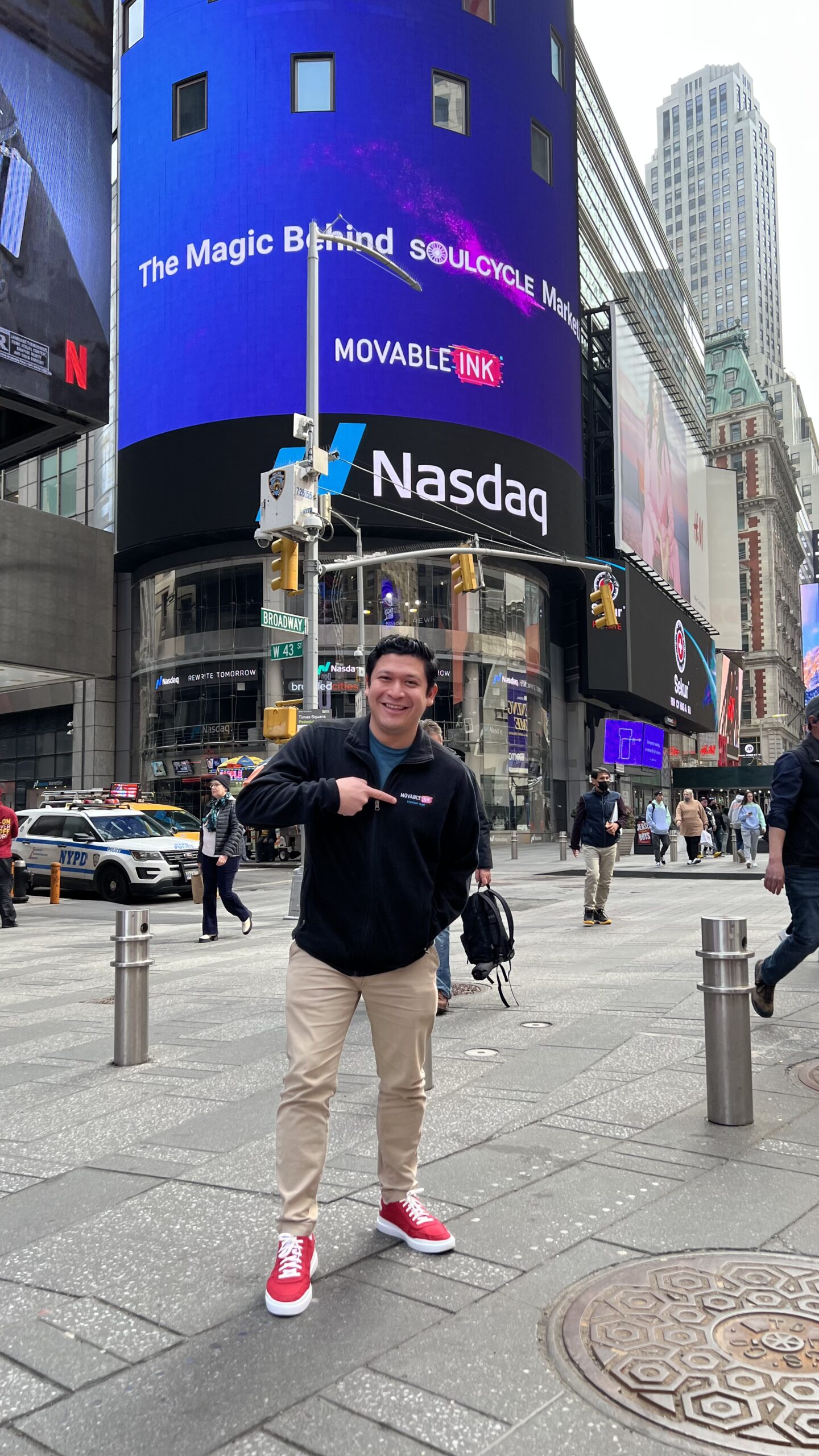
I spent nearly eight years at Movable Ink, moving through several roles, building teams, and helping shape how some of the world's largest retailers approached customer engagement. Looking back, the most valuable lessons weren't about technology or job titles. They were about embracing change, investing in people, staying curious, and recognizing that a career rarely follows the path you originally imagined.
I blinked, and eight years passed. That's how I described my time at Movable Ink when I shared that I was moving on. And looking back, it's still the best way I can explain how quickly those years seemed to go. When I joined the company in 2018, I couldn't have predicted the roles I'd eventually hold, the people I'd work with, or how much the business and the technology industry would change along the way. I certainly didn't imagine that I'd spend nearly eight years there. But what makes that period particularly meaningful to me isn't simply the amount of time. It's how many different experiences fit into it.
In some ways, it felt like several careers within one company. And I learned something from each of them.
Growth doesn't always follow a straight line.
Over the years, my responsibilities evolved from working closely with customers on strategy to leading teams, building capabilities, and eventually serving as Vice President of Strategy and head of the Retail practice. Each role required something different. Early on, much of my focus was on understanding customers, solving problems, and demonstrating how technology could help businesses achieve their goals. As my responsibilities grew, so did the scope of the challenges.
I became increasingly involved in developing people, shaping how teams worked, building strategic programs, and helping the organization think about opportunities across an entire industry. Eventually, my work extended across regions, functions, and some of the world's largest retail brands. The progression might look straightforward on a résumé. It certainly didn't feel that way while I was living it. There were new responsibilities to figure out, decisions I hadn't encountered before, and plenty of moments when I had to learn something quickly. And that's one of the first lessons I take away from the experience.
Career growth isn't simply about becoming better at the job you already know how to do. It's about becoming comfortable doing things you haven't done before. Sometimes that means taking on a new role. Sometimes it means stepping into a difficult project. And sometimes it means recognizing that the skills that made you successful in one position aren't necessarily the same skills you'll need in the next.
Building something is different from inheriting it.
One of the experiences I'm most grateful for was the opportunity to help build and scale capabilities within the organization. That included developing teams, expanding our approach to analytics, and helping shape how strategy supported customer relationships and business growth. There's something particularly rewarding about building something that didn't previously exist in quite the same form. But it also comes with challenges. You don't always have a playbook.
You have to make decisions with incomplete information, bring people along with you, and recognize when an approach that worked at a smaller scale needs to evolve. I learned that building a successful team or function isn't simply about hiring talented people and giving them work. It's about creating clarity around what you're trying to accomplish, establishing ways of working that support those goals, and giving people the opportunity to contribute and grow. It's also about knowing when to get out of the way.
Some of the most satisfying moments in leadership come when you realize that something you helped build no longer depends on you to succeed. That's not a loss of relevance. It's evidence that you've built something sustainable.
The people are what make the experience.
When I think about those eight years, I remember the work. The customer relationships. The presentations. The strategic initiatives. The launches. The challenges we worked through. But more than anything, I think about the people. The colleagues who challenged my thinking. The leaders who trusted me with opportunities I wasn't entirely sure I was ready for. The people I had the privilege of managing, mentoring, and learning from. And the customers who allowed me to become part of conversations about their businesses, not just the technology they purchased.
I was fortunate to work with people across different functions, countries, and backgrounds, each bringing their own perspective to the challenges we were trying to solve. Those relationships made me better at my job. They also made the work more meaningful. One thing I've come to appreciate is that professional relationships aren't simply a byproduct of doing business. They're part of how we learn, grow, and create opportunities for one another. A thoughtful colleague can change how you approach a problem. A great manager can help you recognize potential you haven't yet seen in yourself. And someone you mentor can teach you just as much as you teach them.
The longer I work, the more convinced I become that careers are shaped as much by people as they are by positions.
Leadership changes when the scope gets bigger.
Early in your career, it's natural to focus on demonstrating what you can do. You want to solve problems, deliver strong work, and establish credibility. As you take on broader responsibilities, the definition of success begins to change. It's no longer just about your individual contribution. It's about whether the people around you are equipped to succeed. Whether teams have clarity. Whether the organization is making better decisions. Whether the capabilities you're developing will continue to create value beyond your direct involvement. I found that transition both rewarding and challenging. It required learning when to be directly involved and when to empower others.
When to provide an answer and when to ask a better question. When to advocate strongly for an idea and when to recognize that someone else had a better one. And perhaps most importantly, it required understanding that leadership isn't measured solely by what you accomplish personally. It's also measured by what becomes possible for other people because of your leadership. That's a lesson I continue to carry with me.
Technology changes. The business problems are surprisingly familiar.
One of the fascinating things about spending nearly eight years at a marketing technology company was watching the industry evolve. Customer expectations changed. Privacy and technology developments reshaped how marketers approached engagement. Data and analytics became increasingly important. And artificial intelligence began transforming how organizations thought about personalization, decision-making, and the customer experience. The capabilities available toward the end of my tenure were very different from those available when I started. But many of the fundamental business questions remained remarkably consistent. How do we understand customers better? How do we create more relevant experiences? How do we demonstrate the value of our investments? How do we grow while managing costs and complexity?
How do we build relationships that last? The technology used to answer those questions continues to evolve. The importance of asking them hasn't changed. That perspective has shaped how I approach new technologies today, particularly AI. I'm excited by innovation, but I'm most interested in what it enables people and businesses to accomplish. After all, technology doesn't create business value simply by existing. It creates value when people use it to solve meaningful problems.
Sometimes a chapter ends before you think you're ready.
I won't pretend that every career transition happens according to plan. Sometimes you decide it's time for a new challenge. Sometimes an opportunity appears that you hadn't anticipated. And sometimes circumstances make the decision for you. My time at Movable Ink ended during a period of organizational change. After investing so much of myself in the company, the people, and the work, that transition naturally came with a mix of emotions.
While I was fortunate enough to choose where I would go next (and I'm loving my Validity family!), it didn't make leaving any easier. I was stepping away from a world I knew so intimately that I could practically do my job in my sleep. But perhaps that was also a sign that I'd learned everything I could from that chapter. And for that, I'm grateful. Those eight years gave me opportunities to grow in ways I couldn't have anticipated when I joined. They introduced me to people I hope will remain part of my life and career for years to come.
And they helped shape how I think about strategy, leadership, customer relationships, and the kind of work I find most meaningful. None of that disappears because the circumstances change. A career isn't defined by a single moment. And an experience doesn't lose its value because it eventually comes to an end.
What I'd tell myself eight years ago.
If I could go back to 2018 and offer myself a little advice, I don't think it would be particularly complicated.
Stay curious. The most interesting opportunities may come from problems you haven't encountered before.
Invest in people. Relationships will shape your career in ways that are difficult to predict and impossible to replicate through individual effort alone.
Don't become too attached to a job description. Some of the most valuable experiences will come from responsibilities that weren't originally part of the plan.
Learn to build, not just deliver. Creating something that helps other people succeed can be more meaningful than any individual accomplishment.
Remember that change is inevitable. Organizations evolve, industries transform, and careers take unexpected turns. The ability to adapt is something worth developing.
And finally, take the time to appreciate where you are. It's easy to become so focused on the next milestone that you forget to recognize what you're experiencing along the way. I know I've been guilty of that.
The next chapter.
As I look back on my time at Movable Ink, I'm proud of what we accomplished. I'm grateful for the opportunities I was given, the trust people placed in me, and the relationships that made those years so meaningful. I'm also excited about what comes next. Not because I have every step mapped out. But because the experience reminded me that some of the most rewarding parts of a career are the ones you couldn't have planned. Eight years. Several roles. Countless lessons. And a lot of people to thank. I wouldn't trade the experience. And I'm looking forward to seeing what the next chapter brings.

Julio Lopez
I've spent more than 16 years helping enterprise brands connect their business priorities with the technology and strategies needed to deliver better customer experiences and measurable results.
My career has spanned marketing technology, personalization, AI, and customer engagement, with roles at CheetahMail/Epsilon, RevTrax, Eversight, Movable Ink, and Validity. Throughout that time, I've worked at the intersection of business strategy and technology, helping organizations turn complex capabilities into practical solutions that drive growth, strengthen customer relationships, and deliver meaningful outcomes.
More about Julio ↗