
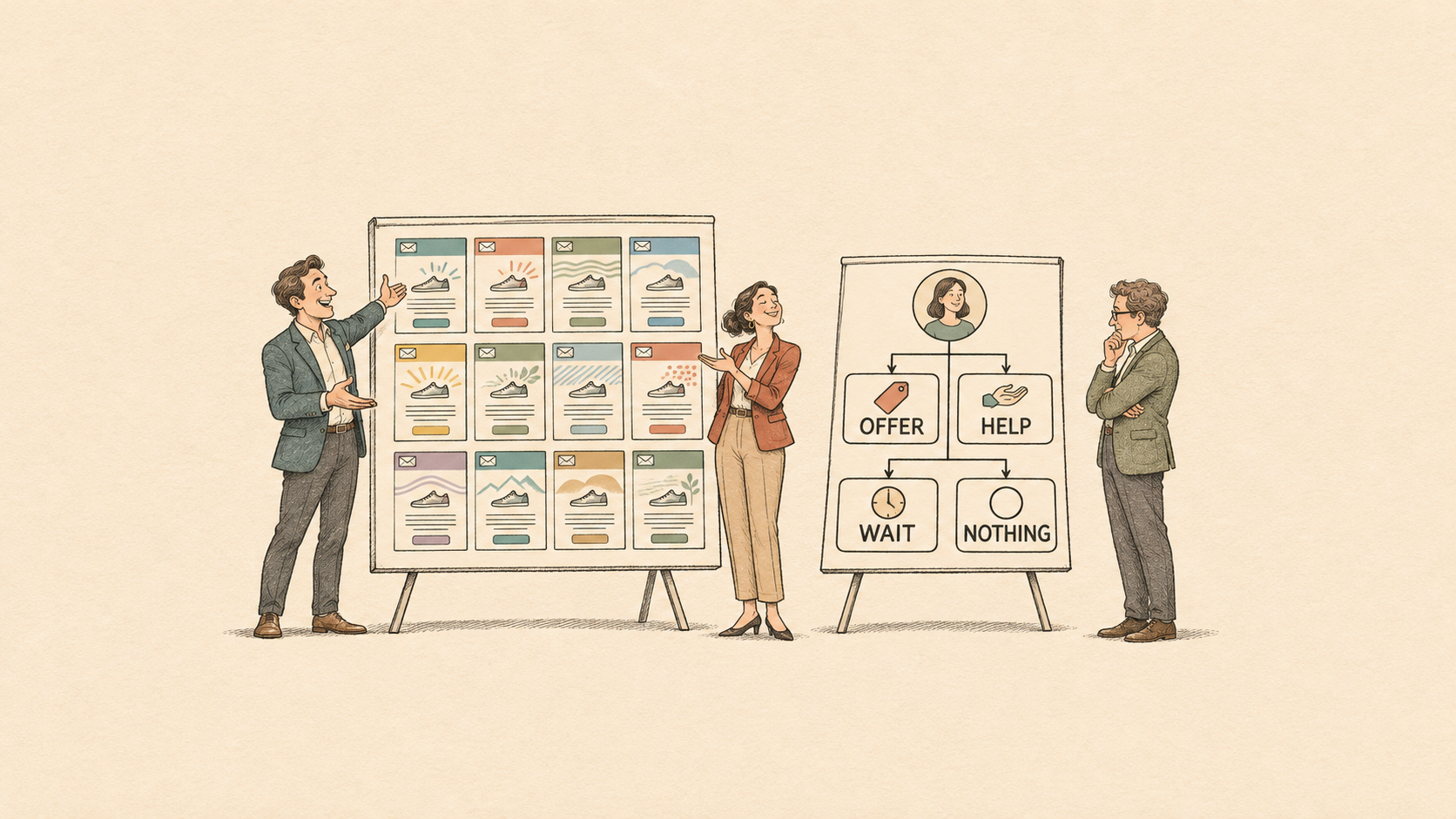
Personalization isn't just about selecting the right content. It's about deciding whether to communicate, which experience will help, and what outcome matters. AI can improve those decisions at scale, but only when customer intent, business objectives, and connected channels guide the technology.
After spending much of my career working in marketing technology and personalization, I still get excited when a brand I'm shopping gets the experience just right.
Not necessarily because the email looks beautiful or the website has some impressive new feature. Sometimes it's much simpler than that.
A brand recognizes what I'm trying to accomplish. It makes a relevant recommendation. It remembers something useful from a previous interaction. Or, perhaps most impressively, it knows when to leave me alone.
That last one doesn't get nearly enough attention.
For years, we've talked about personalization primarily in terms of content. The right image. The right headline. The right product recommendation. The right first name in the subject line.
And to be fair, those things matter. You know what it feels like to get a Hello FNAME in an email. FNAME is not MY name!
But after years of working with enterprise retailers, I've become increasingly convinced that the most important part of personalization happens before the content is selected. It's the decision about what experience to deliver in the first place.
We've gotten very good at changing the message.
Marketing technology has made extraordinary progress. Brands can create dynamic content, tailor recommendations, adapt creative based on customer information, and deliver experiences that would have required enormous manual effort not that long ago. Generative AI is accelerating that progress even further.
We can produce more content, create more variations, and experiment with ideas faster than ever before. That's exciting. But it also raises a question I don't think we ask often enough:
Just because we can personalize something, should we?
Imagine a retailer has ten different versions of a promotional email. Different products. Different headlines. Different images. Maybe even different offers. That's a meaningful improvement over sending everyone exactly the same message.
But what if the customer doesn't need another promotional email? What if they recently made a purchase and would benefit more from information about using the product? What if they're researching a category but aren't ready to buy? What if they're a loyal customer who's already receiving too many messages? Or what if the most appropriate decision is not to send anything at all?
Suddenly, the challenge isn't which version of the email to show. It's whether the email is the right experience to begin with. And that's a very different problem.
Relevance starts with understanding intent.
One of the most interesting shifts in personalization is the move from focusing primarily on who a customer is to understanding what they might be trying to accomplish.
Traditional segmentation has often relied on relatively stable characteristics: purchase history, loyalty status, demographics, category preferences, previous engagement. All useful signals. But people aren't static.
Someone who usually shops for themselves might suddenly be looking for a gift. A customer who regularly buys full-price merchandise might be waiting for a particular promotion. Someone who hasn't purchased in months might be researching a major purchase rather than losing interest in the brand.
The same customer can have very different needs depending on the moment. And that's where intent becomes so important.
Instead of simply asking, "What do we know about this customer?" we should also ask, "What might this customer be trying to do right now?"
That doesn't mean technology can read minds. It means using available signals, recognizing uncertainty, and making more informed decisions about what might be helpful. It also means being willing to change course when new information becomes available.
A recommendation that made sense yesterday might not make sense today. And a customer experience that never adapts isn't particularly personalized, no matter how many dynamic content elements it contains.
AI changes the scale of the decision.
This is where AI becomes especially interesting to me. Not simply because it can generate more content, but because it can help organizations evaluate more possibilities.
Consider all the decisions involved in a single customer interaction:
- Should we communicate at all?
- Which channel makes the most sense?
- What should we talk about?
- Which product or category is relevant?
- Should we offer an incentive?
- What creative approach is most appropriate?
- And what are we actually trying to accomplish with this interaction?
Historically, many of these decisions have been made through a combination of business rules, campaign calendars, segmentation strategies, and human judgment. There's nothing inherently wrong with that approach. Rules are useful. Human judgment remains essential.
But as the number of customers, signals, channels, and possible experiences grows, the complexity becomes difficult to manage manually. AI-driven decisioning creates an opportunity to evaluate that complexity more effectively.
The important distinction is that AI isn't just helping us create the options. It's helping us determine which option makes sense.
Of course, that doesn't mean we should hand every decision to an algorithm and hope for the best. The system still needs clear objectives, appropriate constraints, reliable information, and a way to measure whether its decisions are producing the intended results.
Because an algorithm can become extremely effective at optimizing the wrong thing. Which brings us to another important question.
What are we optimizing for?
Marketing teams have spent years measuring opens, clicks, conversions, and revenue. Those metrics are useful. I've worked with them throughout my career. But they're not all equally good indicators of customer value.
A campaign can generate a strong click-through rate without creating meaningful incremental business impact. A discount can drive a conversion that might have happened anyway. An aggressive messaging strategy can increase short-term revenue while contributing to fatigue or disengagement over time.
If we ask AI to maximize a particular metric, we shouldn't be surprised when it finds ways to do exactly that. The more interesting question is whether we've chosen the right objective.
Are we trying to drive an immediate transaction? Increase the likelihood of a second purchase? Build a stronger long-term relationship? Help a customer discover something relevant? Or avoid unnecessary communication that could damage engagement?
Different objectives can lead to different decisions. And the most valuable decision isn't always the one that produces the most immediate activity. Sometimes it's the one that creates a better outcome over time.
That's a harder thing to measure. It's also a much more interesting problem to solve.
The customer doesn't experience channels.
There's another reason I think decisioning matters more than content alone. Customers don't organize their relationships with brands into email, mobile, web, paid media, and in-store experiences. Marketing departments do.
A customer might discover a product on social media, research it on a website, visit a store, and eventually make a purchase through an app. To the customer, that's one relationship with one brand.
But inside the organization, those interactions may be managed by different teams, different systems, and different sets of performance metrics. And when those systems don't communicate, personalization starts to feel remarkably impersonal.
You buy a product and continue receiving ads for it. You browse a category on the website, but the next email seems completely disconnected from your interests. You tell a brand what you prefer, only to discover that the preference apparently didn't make it to another channel.
We've all experienced some version of this. And it illustrates why creating more personalized content isn't enough.
If each channel is making decisions independently, the customer can still end up with a fragmented experience. I've said this on many stages: consumers don't shop Brand X is mobile, and Brand X in email, they simply shop Brand X!
The opportunity is to make decisions with a more complete understanding of the relationship, while respecting customer preferences and privacy. That doesn't require every interaction to be identical. It requires them to make sense together.
More personalization isn't necessarily better personalization.
One of the things I find fascinating about this space is that the technology keeps expanding what's possible. We can generate more variations. Analyze more signals. Automate more decisions. Respond more quickly.
But none of those capabilities guarantees a better customer experience. In fact, without clear objectives, they can make it easier to deliver more of the wrong thing.
More irrelevant recommendations. More unnecessary messages. More experiences that technically qualify as personalized but don't feel particularly helpful.
I think the next phase of personalization will require us to become more disciplined about the decisions we're making, not simply more ambitious about the content we're producing.
That means connecting technology to business strategy. It means thinking beyond individual campaigns. It means understanding customer intent, measuring incremental value, and recognizing that the right decision can sometimes be to do less.
And it means remembering that the customer is not sitting around admiring our personalization capabilities. They're trying to accomplish something.
If we can make that experience easier, more relevant, or more useful, we're doing our job. If all we've done is find a more sophisticated way to put their first name in an email, we might have a little more work to do.

Julio Lopez
I've spent more than 16 years helping enterprise brands connect their business priorities with the technology and strategies needed to deliver better customer experiences and measurable results.
My career has spanned marketing technology, personalization, AI, and customer engagement, with roles at CheetahMail/Epsilon, RevTrax, Eversight, Movable Ink, and Validity. Throughout that time, I've worked at the intersection of business strategy and technology, helping organizations turn complex capabilities into practical solutions that drive growth, strengthen customer relationships, and deliver meaningful outcomes.
More about Julio ↗